
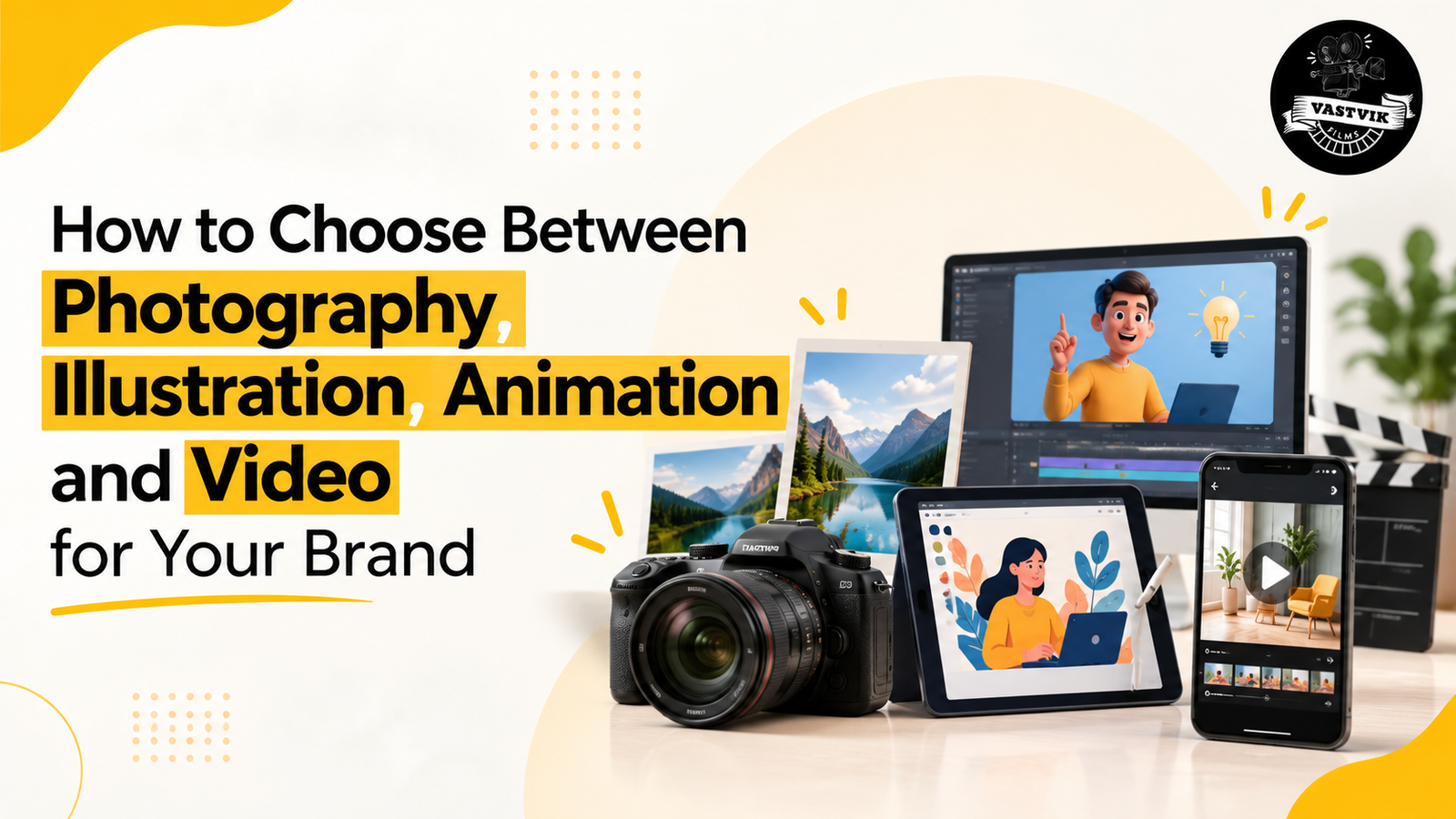
How to Choose Between Photography, Illustration, Animation and Video for Your Brand
By Vastvik Films | Video production house in Mumbai and Chandigarh
Most brands start a campaign by saying, “We need a video.” Then the video gets made, it looks great, and nobody can say what it was supposed to do. We have seen this many times as a video production company in Mumbai, and the problem is almost never the quality of the video. It is that the format was picked before the goal was.
This guide helps you pick between photography, illustration, animation and live-action video, based on what you want your audience to understand, believe or do.
Quick Answer
Use photography when people need to see something real. Use illustration when the idea cannot be photographed. Use animation when you need to explain a process or sequence. Use live-action video when people, emotion and movement carry the message. For most campaigns, a smart mix of two formats beats going all-in on one.
Decide What the Viewer Should Do First
Before you open a brief or call a production house, answer one question: what should the viewer do or feel after seeing this?
If the answer is “trust us enough to call,” you need real faces and real places. If it is “finally understand how our software works,” you need a clear explanation. If it is “remember our brand tomorrow,” you need emotion and a strong idea. Each of those points to a different format.
Photography: Best When You Need to Show Proof
Photography works when proof matters. A buyer looking at a flat wants to see the actual flat. A restaurant owner wants to see the actual kitchen before hiring a caterer. A real photograph says “this exists, and this is what it looks like.”
Use photography for:
- ● Product catalogues and e-commerce listings
- ● Team, factory and office pages that build credibility
- ● Event coverage and brand archives
- ● Supporting images for blogs, decks and social posts
Stock photos are fine for backgrounds and generic situations. They stop working the moment the viewer is trying to judge you. A stock image of a smiling team on your About page tells people nothing, and most of them can tell.
Illustration: Best for Ideas You Cannot Photograph
Some ideas simply cannot be photographed. How a fintech app keeps money safe, how a medicine works inside the body, how a supply chain moves across five cities: there is nothing to point a camera at. Illustration gives you freedom and consistency. You control colours, characters and style, so your campaign looks like one family across Instagram, a website and a pitch deck.
The limit is trust. If the viewer needs to confirm that the product, place or result is real, an illustration will not do that job. Use it to explain, not to prove.
Animation: Best for Processes and Explainers
Animation is the best format when something changes over time or happens somewhere you cannot film: a software workflow, a three-step service, data moving between systems, a building that is still under construction. It is also very common in e-learning video production, where a trainer needs to break a complex topic into small, easy steps and keep a learner’s attention for several minutes. Animation lets you show one idea at a time, in the order you choose.
A simple test: remove the movement and see if the idea becomes harder to follow. If it does not, you are paying for motion that adds nothing. Good animation directs attention. Bad animation just moves.
Live-Action Video: Best for People, Emotion and Stories
Live-action video is the strongest format when people and presence matter: a founder explaining why the company exists, a customer saying in their own voice why they stayed, a factory tour, a product being used in a real room. Tone of voice, a pause, a smile, the sound of a place: none of that survives in text or a still image. This is why most corporate video production projects, such as brand films, testimonials and leadership messages, are shot live-action. It is also the backbone of an ad film, where emotion is doing the selling.
The trade-off is flexibility. Locations, talent, equipment and schedules all have to line up, and changing one line after the shoot can mean reshooting. Plan the script properly before the camera comes out.
Quick Comparison
| Format | Best for | Watch out for |
| Photography | Proof, products, real places and people | Generic stock images that say nothing |
| Illustration | Abstract ideas, consistent brand look | Cannot prove something is real |
| Animation | Processes, explainers, training, things you cannot film | Motion with no purpose |
| Live-action video | Emotion, testimonials, brand stories, ads | Higher planning effort, harder to edit later |
Which Format Suits Which Industry
● Real estate. Buyers want to feel a space, not just see it. Walkthrough video and drone shots in live action do most of the work, while photography supports listings and brochures. If the project is still under construction, add 3D or animated walkthroughs. This is the core of real estate video production.
● E-learning and training. Animation or screen-based explainers, with an on-camera trainer for credibility, usually work best. Learners switch off during long lectures, so short and structured wins.
● Corporate and B2B. Start with live-action for leadership, culture and testimonials. Add animated explainers for services that are hard to describe in one line.
● Consumer brands and ads. Live-action ad films for emotion, photography for product detail, short animated or illustrated pieces for social formats and offers.
● Government and public awareness. Illustration and animation travel well across languages and literacy levels, and live-action brings in real voices from the ground.
Combining Formats Without Making a Mess
The best campaigns we see rarely use a single format. A live-action product demo with animated labels pointing at key features. A brand film that cuts to a short animation to explain the part that cannot be shot. A photo series on social, with a video as the hero piece.
The rule is simple: every format in the mix must do something the others cannot. If you are combining them only to make the piece look busier, you are adding cost without adding clarity.
Plan for Where the Content Will Run
A film made for a conference screen is not the same as one made for an Instagram Reel, a YouTube pre-roll or an email. Decide the destination first. Vertical or horizontal, sound-on or sound-off, ten seconds or two minutes: these choices change what you shoot and how you edit it.
Common Mistakes Brands Make
- ● Choosing the format because a competitor did. Their goal is not your goal.
- ● Using stock photography where trust is the point.
- ● Paying for animation when a simple shot would do.
- ● Skipping the script. Fixing a weak script in the edit costs more than writing it properly.
- ● Making one big video and nothing else. One shoot can also give you photos, short cuts and social clips if you plan for it.
How to Decide in Five Minutes
Ask yourself four questions.
- ● Does the audience need to see something real? Use photography or live-action.
- ● Does the idea have no physical form? Use illustration or animation.
- ● Is it a process or sequence? Use animation.
- ● Do people, voice and emotion carry the message? Use live-action video.
If you answered yes to more than one, you probably need a mix, and that is a good thing to discuss with your production team before the budget is fixed.
FAQs
● Which is better for marketing, video or photography? Neither is better by default. Photography is best for showing real products, places and people clearly. Video is better when movement, voice and emotion matter. Many brands use both from the same shoot.
● When should I choose animation over live-action video? Choose animation when you need to explain a process, show something that cannot be filmed, or keep changing the content easily. Choose live-action when real people, products or locations are central to the message.
● Is illustration cheaper than photography or video? Not always. A simple illustration set can be cheaper than a shoot, but detailed custom illustration or animation takes serious design time. Cost depends on the amount of work, not the format name.
● Can I use more than one format in one campaign? Yes, and it usually works better. Give each format one clear job, such as live-action for trust and animation for explaining.
● How do I choose the right video production house? Look at their work in your industry, ask who will actually shoot and edit your project, and check that they plan the script and the final destination before they plan the shoot.
Final Thought
The right format is the one that makes your message clearer. Start with what the audience needs to understand or feel, and the choice usually becomes obvious. Planning a campaign and not sure which format fits? Talk to Vastvik Films. We are a video production house working with brands in Mumbai and Chandigarh across corporate films, ad films, real estate, e-learning and more. Tell us your goal, and we will tell you honestly what you need and what you do not.