
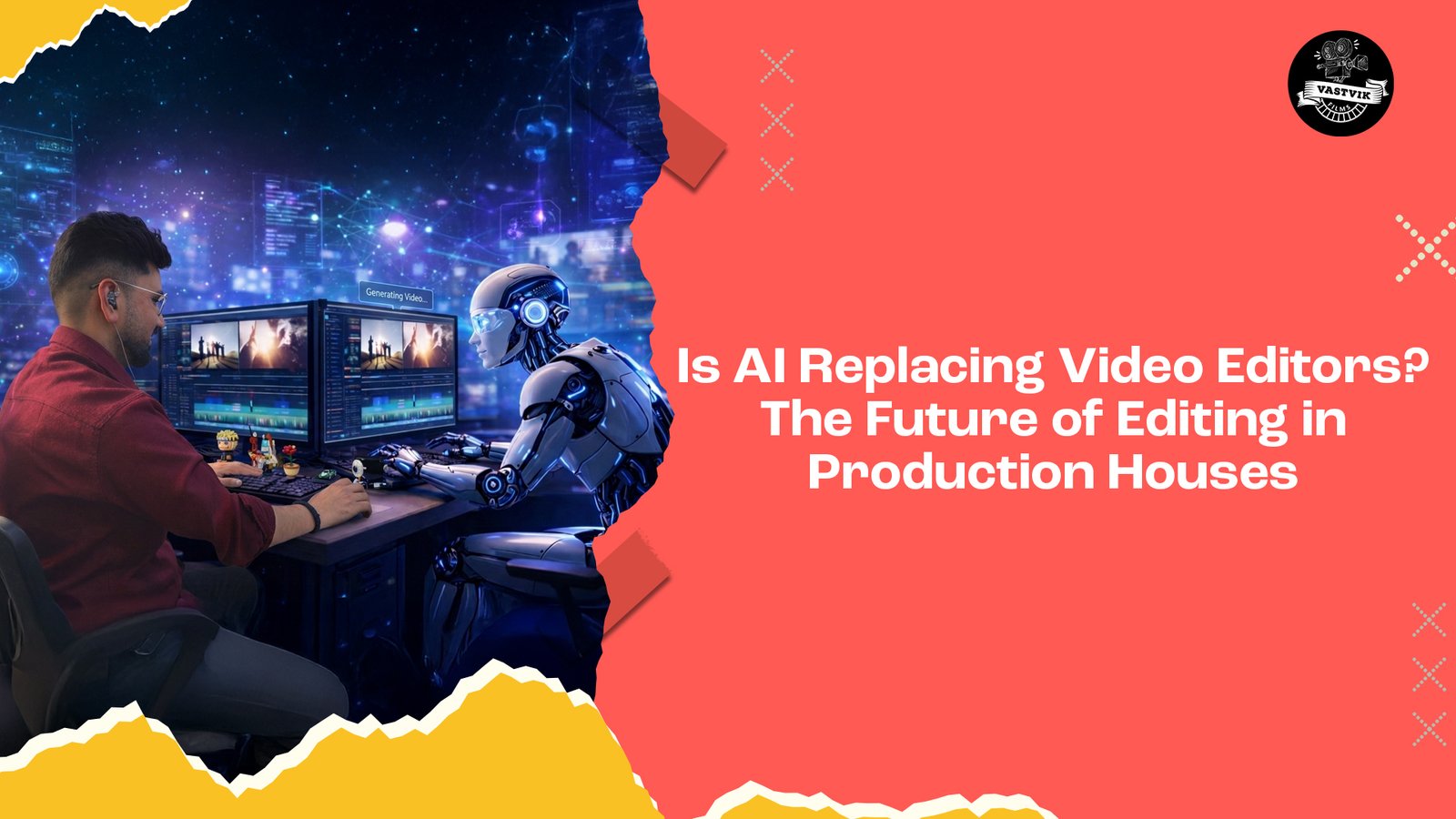
Is AI Replacing Video Editors? The Future of Editing in Production Houses
Artificial intelligence is rapidly changing the creative industry. Many tools are coming which now automate subtitles and do quick edits. This massive evolution has sparked a very important question in the media industry: Is AI replacing video editors? Although AI is making video editing quick and simple, the truth is not that simple. In this blog, we will discover whether AI is replacing the video editors or transforming how professionals operate and collaborate with modern production houses. The rise of AI in video editing has made editing faster and more accessible than ever before.
The Rise of AI in Video Editing
AI tools for video editing have become very common in recent years. These tools are so smart that they can automatically find scenes, remove background noise, fix colours and even create a basic version of the video. AI acts as a perfect assistant for video editors, as it saves a lot of time by performing repetitive tasks that would usually take a lot of time.
For example, AI can:
- ● Create subtitles very quickly
- ● Stable shaky images
- ● Analyse videos and suggest edits
- ● Automatically remove silent parts
Popular AI Video Editing Tools Used in 2026
The growth of artificial intelligence has introduced several powerful video editing platforms that help creators work more efficiently. These tools are widely used by content creators, marketers, agencies, and production houses to automate repetitive tasks while maintaining high-quality output.
Some of the most popular AI-powered video editing tools in 2026 include:
● Adobe Premiere Pro AI Features
● CapCut AI Editor
● Runway AI
● Descript
● Wondershare Filmora AI Tools
● DaVinci Resolve Neural Engine
These platforms can automatically generate subtitles, remove background noise, identify key moments in footage, improve audio quality, and speed up editing workflows. While these features improve productivity, human editors still play a crucial role in shaping the final story and creative direction.
Will AI Replace Video Editors in 2026?
Artificial intelligence has advanced rapidly, making video editing more efficient than ever before. While AI can automate many technical tasks, it cannot completely replace human editors. Professional editing requires creativity, storytelling, emotional understanding, and strategic thinking. In 2026 and beyond, the editors who combine their creative skills with AI tools will be the most successful. Rather than replacing editors, AI is becoming a powerful assistant that helps them work faster and smarter.
What AI Can Do Better Than Human Editors
AI performs repetitive and time-consuming editing tasks much faster than humans. Modern AI tools can automatically generate captions, remove background noise, organise footage, create rough cuts, detect scenes, and even recommend transitions. These features help production teams save time and improve efficiency. By handling technical processes, AI allows editors to focus more on storytelling and creative decision-making.
Why AI Cannot Replace Video Editors
Video editing is not limited to cuts, adding clips or adjusting frames; it is way more than that. AI is so powerful and can do a lot, but AI doesn’t have a creative mind. A perfect video involves a creative storyboard, amazing visuals, and a balance of emotions and rhythm.
Professional video editors know the story flow, audience perception and the brand’s tone; they make all creative decisions that AI can’t.
For instance, when editing a brand film or cinematic advertisement, editors must decide:
- ● Which shot will create more emotional impact
- ● How visuals will sync with music
- ● When to adjust video speed
- ● How to maintain brand consistency through video
These creative decisions are so important which humans can take.
What AI Still Cannot Replace
Despite its technological capabilities, AI cannot understand emotions, audience psychology, brand messaging, or creative storytelling the way humans do. Great videos require a unique vision, emotional depth, and creative judgment that comes from experience. AI can analyse patterns and automate tasks, but it cannot truly understand what makes a story memorable. This is why human editors remain essential for commercials, documentaries, corporate films, and cinematic productions.
AI vs Human Video Editors: A Practical Comparison
Although AI tools are becoming increasingly sophisticated, they are designed to assist editors rather than replace them. Understanding the strengths of both can help businesses choose the right approach for their video projects.
| Feature | AI Video Editing | Human Video Editing |
|---|---|---|
| Editing Speed | Very Fast | Moderate |
| Creativity | Limited | High |
| Storytelling Ability | Basic | Advanced |
| Emotional Understanding | Limited | Strong |
| Brand Strategy | Limited | Strong |
| Problem Solving | Rule-Based | Experience-Based |
The most effective video production workflows in 2026 combine AI automation with human creativity. This approach improves efficiency while maintaining storytelling quality and brand consistency.
How Production Houses Are Using AI
Today, many production houses are not replacing editors with AI, but they are aligning AI with their workflow. Production houses are using AI for repetitive and technical tasks; meanwhile, editors can focus on creative storytelling. With this combination, the production house can speed up its workflow and quality.
Production houses use AI for these things:
- ● Automatic transcription and subtitles
- ● Smart scene detection
- ● AI colour matching between clips
- ● Automated rough cuts for long interviews
With this practice, video editors can focus more on important editing tasks.
The Future of Video Editing
In the future, video editing will rely so much on AI. Editors who learn this skill will be more valuable and efficient. AI will not harm any editor, but it will make them more creative and improve their quality of work.
Industry experts believe the role of editors will change into:
- ● Storytelling creators
- ● Visual content strategists
- ● Content optimisation professionals
- ● AI-powered video editors
According to HubSpot, AI tools are helping creators automate repetitive editing tasks and focus more on storytelling.
Future of Video Editing Jobs After AI
The future of video editing is not about AI replacing professionals but about collaboration between humans and technology. Editors who learn AI-powered tools will gain a significant advantage in the industry. As video content demand continues to grow, businesses will need professionals who can combine technical efficiency with creative expertise. The role of editors will evolve into strategic storytellers, creative directors, and content specialists who use AI to enhance productivity and quality.
How Brands and Businesses Benefit from AI-Assisted Video Editing
Businesses today produce content across multiple platforms, including websites, social media channels, digital advertising campaigns, and internal communications. AI-assisted editing helps organisations manage this growing demand more efficiently.
Key benefits include:
● Faster content turnaround times
● Reduced editing workload
● Improved subtitle and caption generation
● Better content repurposing for different platforms
● Consistent video formatting and optimisation
However, successful marketing videos still require strategic planning, creative storytelling, and audience understanding. This is why brands continue to rely on experienced video editors and production professionals to guide the creative process.
Frequently Asked Questions (FAQs)
● Can AI replace video editors completely?
No. AI can automate repetitive editing tasks, but it cannot replace creativity, storytelling, and emotional intelligence.
● Will AI take over video editing jobs?
AI is expected to transform video editing jobs rather than eliminate them. Editors who adopt AI tools will remain highly valuable in the industry.
● Is video editing still a good career in 2026?
Yes. The demand for video content continues to grow, creating strong opportunities for skilled video editors and content creators.
● Should video editors learn AI tools?
Absolutely. Learning AI-powered editing tools can improve productivity, streamline workflows, and help editors stay competitive in a rapidly evolving industry.
Final Thought
Artificial intelligence is changing the world of video editing, but it can never replace video editors. People often debate whether AI will replace a video editor, but it’s not true; AI can act as a creative assistant, but not a replacement. Production houses like Vastvik Films have seen remarkable results after integrating AI into their workflows. In future, it will not be AI vs Video editor, it will be a combination of both. Production houses should accept AI and consider it as an upgrade because AI will help them to improve their efficiency, quality and speed of work.